Slotted Nut
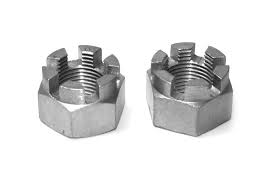
Slotted nuts are hexagonal nuts with slots (cut-outs) on the top surface, designed to be used with a cotter pin (split pin) for mechanical locking. When installed on a drilled bolt or stud, the slots align with the hole, allowing insertion of a cotter pin to prevent rotation and loosening under vibration or dynamic loads.
They are widely used in applications requiring secure locking and safety retention, especially in rotating or moving assemblies.
Types of Slotted Nuts
- Standard Slotted Hex Nut: Common type with vertical slots
- Heavy Slotted Nut: hicker design for higher load applications
- Castle Nut: Similar to slotted nut but with extended cylindrical top (castellated design)
- Stainless Steel Slotted Nut: For corrosion-resistant environments
Applicable Standards
Dimensional Requirements:
- DIN 935 – Slotted hex nuts
- ASME B18.2.2 – Slotted and castellated nuts
- ISO 7035 / ISO 7036 – Slotted nuts (metric series)
- ASTM A563 / ASTM A194 – Material specifications
Material Grades:
- Carbon Steel (ASTM A563)General-purpose applications
- Alloy Steel (ASTM A194): High-strength applications
- Stainless Steel (AISI 304 / 316, ASTM A194 B8 / B8M): Corrosion-resistant
- Special Alloys:For high-temperature or corrosive environments
Material Grades (Commonly Used)
High Tensile, Stainless Steel, Alloy Steel, Inconel, Incoloy, Hastelloy, Monel, Silicon Bronze, Phosphor Bronze, Aluminium Bronze, Nickel, Brass, Copper, Copper Nickel,Duplex, Super Duplex, Titanium Alloys, CB20, Nitronic, Nimonic, ASME, ASTM etc…
Technical Specifications
- Diameter Range: M6 to M100 / ¼” to 4”
- Thread Type: UNC / UNF / Metric
- Slot Design: Evenly spaced vertical slots for cotter pin insertion
- Height:Standard or heavy pattern
Surface Protection / Coating:
- PTFE Coated (Blue, Yellow, Red, Green & Black)
- Hot Dip Galvanized
- Yellow Zinc Plated or Cadmium Plated
- Blue Zinc Plated
- Molykote
- Aluminium Zinc Flake Coated
- Black Phosphate
- Zinc Plated
- Nickel Plated
Engineering Applications
- Automotive steering and suspension systems
- Axles, shafts, and rotating components
- Machinery requiring secure locking
- Aerospace and marine applications
- Heavy equipment and industrial assemblies
Performance & Key Features
- Positive mechanical locking using cotter pin
- Prevents loosening under vibration and dynamic loads
- Suitable for rotating and safety-critical applications
- Reusable with proper cotter pin replacement
- Provides visual confirmation of locking
Installation Method
- Tighten the nut to the required torque
- Align slots with the hole in the bolt or stud
- Insert cotter pin through aligned hole
- Bend cotter pin ends to secure the assembly
Design Considerations
- Ensure bolt/stud is drilled for cotter pin
- Select correct slot alignment and nut height
- Replace cotter pin after removal (do not reuse)
- Match material grade with bolt for strength compatibility
- Consider corrosion protection for outdoor environments