
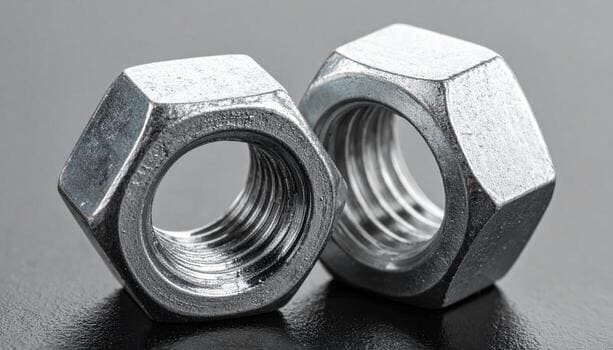
Hex Nut
Hex nuts are six-sided fasteners used with bolts, screws, or studs to create secure mechanical joints. They provide reliable clamping force, maintain load integrity, and are widely used in general, industrial, and structural applications.
Key Features
- Six-sided design allows easy wrenching and installation
- Standard height suitable for a wide range of bolts
- Provides consistent thread engagement and load distribution
Material & Standards
- Carbon Steel: ASTM A563 Grade A/B – General-purpose applicationst
- Alloy Steel: ASTM A194 Grade 2H – High-strength and industrial applications
- Stainless Steel: AISI 304 / 316 (ASTM A194 8 / 8M) – Corrosion-resistant applications
- Standards: ASME B18.2.2 (inch series), ISO 4032 / DIN 934 (metric series)
Technical Specification:
- Diameter Range:M3 to M160 / 8” to 6”
- Thread Type:UNC / UNF / Metric (coarse & fine)
Material Grades (Commonly Used)
High Tensile, Stainless Steel, Alloy Steel, Inconel, Incoloy, Hastelloy, Monel, Silicon Bronze, Phosphor Bronze, Aluminium Bronze, Nickel, Brass, Copper, Copper Nickel,Duplex, Super Duplex, Titanium Alloys, CB20, Nitronic, Nimonic, ASME, ASTM etc…
Surface Protection / Coating:
- PTFE Coated (Blue, Yellow, Red, Green & Black)
- Hot Dip Galvanized
- Yellow Zinc Plated or Cadmium Plated
- Blue Zinc Plated
- Molykote
- Aluminium Zinc Flake Coated
- Black Phosphate
- Zinc Plated
- Nickel Plated
Applications
- Machinery and equipment assembly
- General construction and fabrication
- Structural steel connections
- Piping systems and industrial equipment
Performance & Key Features:
- Provides secure clamping for bolts and studs
- Resists loosening under vibration when paired with lock nuts or washers
- Can be used in high-strength or corrosive environments depending on material selection
- Suitable for standard and critical mechanical joints
Design Considerations:
- Match nut material and grade with the corresponding bolt
- Apply correct torque to avoid thread stripping or over-tightening
- Use washers where load distribution or softer materials require it
- Material selection based on environmental and mechanical requirementse