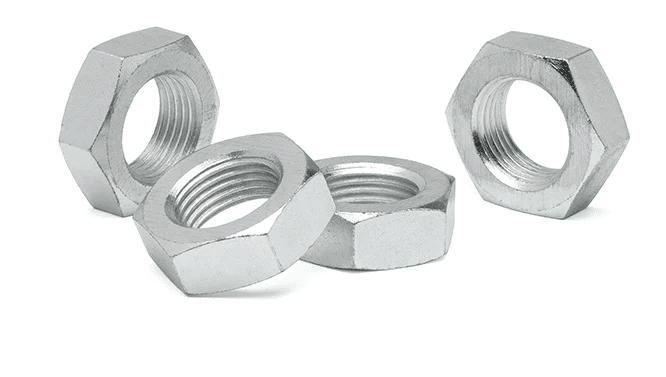
Hex Jam Nut
Hex jam nuts are low-profile (thin) hexagonal nuts designed to be used in conjunction with standard hex nuts to create a locking mechanism. They are typically tightened against a primary nut to prevent loosening due to vibration or dynamic loading. Due to their reduced thickness, jam nuts provide limited load-bearing capacity when used alone and are primarily intended for locking applications rather than structural fastening..
Material & Standards
- Carbon Steel: ASTM A563 – General-purpose applications
- Alloy Steel: ASTM A194 (lower grades) – Moderate strength applications
- Stainless Steel: AISI 304 / 316 (ASTM A194 8 / 8M) – Corrosion-resistant
- Special Alloys: For high-temperature or corrosive environments
Standards
Dimensional Requirements:
- ASME B18.2.2 – Inch series jam nuts
- DIN 439 / ISO 4035 – Metric jam nuts
- ASTM A563 / ASTM A194 – Material specifications
Material Grades (Commonly Used)
High Tensile, Stainless Steel, Alloy Steel, Inconel, Incoloy, Hastelloy, Monel, Silicon Bronze, Phosphor Bronze, Aluminium Bronze, Nickel, Brass, Copper, Copper Nickel,Duplex, Super Duplex, Titanium Alloys, CB20, Nitronic, Nimonic, ASME, ASTM etc…
Technical Specifications:
- Diameter Range:M6 to M64 / ¼” to 2-½”
- Thread Type: UNC / UNF / Metric
- Nut Height: Approximately 50–60% of standard hex nut height
Surface Protection / Coating:
- PTFE Coated (Blue, Yellow, Red, Green & Black)
- Hot Dip Galvanized
- Yellow Zinc Plated or Cadmium Plated
- Blue Zinc Plated
- Molykote
- Aluminium Zinc Flake Coated
- Black Phosphate
- Zinc Plated
- Nickel Plated
Engineering Applications
- Locking mechanism in bolted assemblies
- Machinery and equipment subject to vibration
- Automotive and mechanical systems
- Piping supports and light structural applications
Performance & Functionality
- Acts as a secondary locking element when tightened against a standard nut
- Reduces the risk of loosening due to vibration or movement
- Suitable for applications where space constraints exist
- Not recommended as a primary load-bearing nut
Installation Method (Best Practice)
- Tighten the main hex nut to the required torque
- Install the jam nut and tighten it against the main nut
- Apply reverse torque to lock both nuts securely
Key Features
- Reduced height compared to standard hex nuts
- Prevents loosening under vibration and cyclic loads
- Lightweight and space-efficient for compact assemblies
Design Considerations
- Do not use jam nuts alone in high-load applications
- Ensure proper torque sequence for effective lockings
- Match material grade with mating bolt and primary nut
- Consider corrosion protection based on environment