Hex Weld Nut
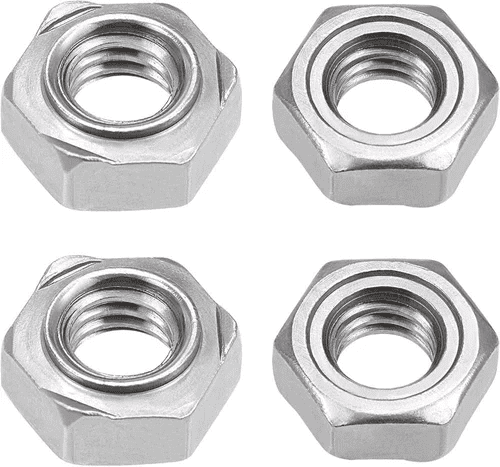
Hex weld nuts are internally threaded fasteners specifically designed to be permanently welded to a base material, providing a strong and reliable threaded connection. They are typically used where access to the reverse side is limited or where a fixed nut is required for repeated assembly. Weld nuts ensure accurate positioning, high strength, and consistent alignment in fabrication and manufacturing processes.
Types of Hex Weld Nuts
- Projection Weld Nut: Equipped with projections (weld points) for resistance welding
- Spot Weld Nut: Designed for spot welding applications
- Hex Weld Nut (Plain): Standard hex shape for manual or automated welding
- Flanged Weld Nut: Includes flange for better load distribution
- Stainless Steel Weld Nut: For corrosion-resistant applications
Applicable Standards
Dimensional Requirements:
- DIN 929 – Hex weld nuts
- ISO 21670 – Weld nuts
- AWS D1.1 – Structural welding code (guidelines)
- ASTM A563 / A194 – Material standards
Material Grades:
- Low Carbon Steel: Suitable for welding applications (most common)
- Alloy Steel: For higher strength requirements
- Stainless Steel (AISI 304 / 316): Corrosion-resistant and weldable grades
- Special Alloys:For high-temperature or corrosive environments
Technical Specifications
- Diameter Range: M4 to M24 / #8 to 1”
- Thread Type: UNC / UNF / Metric
- Weld Projections: Typically 3 or 4 projections for resistance welding
- Surface ConditionClean, weldable surface (oil-free)
- Finish / Coating: Plain (preferred for welding) , Zinc plated (post-weld plating recommended) , Phosphate coating (for temporary protection)
Engineering Applications
- Automotive body and chassis assembly
- Sheet metal fabrication
- Electrical enclosures and panels
- Machinery and equipment manufacturing
- Structural and industrial fabrication
Performance & Key Features
- Provides permanent and secure threaded connection
- Eliminates need for access to backside during assembly
- Ensures accurate positioning and alignment
- Suitable for automated welding processes
- High resistance to vibration and loosening
Design & Welding Considerations
- Ensure proper weld projection contact and alignment
- Use compatible material for base metal and weld nut
- Control welding parameters (current, pressure, time)
- Avoid pre-coating before welding (can affect weld quality)
- Post-weld inspection for weld integrity and thread condition
Inspection & Quality Control
- Visual inspection of weld integrity
- Thread gauge verification (GO/NO-GO)
- Weld strength testing (as per project requirements)
- Coating thickness check (if post-treated)