Nyloc Nut (Nylon Insert Lock Nut)
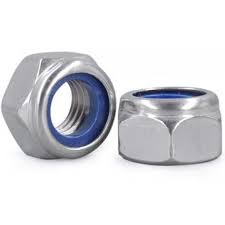
Nyloc nuts are prevailing torque lock nuts that incorporate a non-metallic nylon insert at the top of the nut. This insert deforms elastically around the mating bolt threads, creating friction that resists loosening under vibration and dynamic loading. Nyloc nuts provide a reliable, reusable locking mechanism without the need for additional locking devices such as washers or double nuts.
Material & Standards
- Carbon Steel: ASTM A563 / SAE J995 – General-purpose
- Alloy Steel: For higher strength requirements
- Stainless Steel: AISI 304 / 316 (ASTM A194 8 / 8M) – Corrosion-resistant
Standards
Dimensional Requirements:
- ASME B18.16.6 – Nylon insert lock nuts (inch series)
- DIN 985 / DIN 982 – Metric Nyloc nuts
- ISO 7040 / ISO 10511 – Prevailing torque type hex nuts
Material Grades (Commonly Used)
High Tensile, Stainless Steel, Alloy Steel, Inconel, Incoloy, Hastelloy, Monel, Silicon Bronze, Phosphor Bronze, Aluminium Bronze, Nickel, Brass, Copper, Copper Nickel,Duplex, Super Duplex, Titanium Alloys, CB20, Nitronic, Nimonic, ASME, ASTM etc…
Technical Specifications
- Diameter Range: M3 to M64 / #4 to 2-½”
- Thread Type: UNC / UNF / Metric
- Temperature Limit: Typically up to 120°C (nylon insert limitation)
- Prevailing Torque: As per ISO / DIN requirements
Surface Protection / Coating:
- PTFE Coated (Blue, Yellow, Red, Green & Black)
- Hot Dip Galvanized
- Yellow Zinc Plated or Cadmium Plated
- Blue Zinc Plated
- Molykote
- Aluminium Zinc Flake Coated
- Black Phosphate
- Zinc Plated
- Nickel Plated
Engineering Applications
- Automotive and transport equipment
- Machinery and equipment assemblies
- Electrical and electronic enclosures
- Light structural and industrial applications
- Applications subjected to vibration or movement
Performance & Functionality
- Provides consistent locking force through nylon deformation
- Effective in reducing loosening due to vibration and shock loads
- Maintains clamp load without additional locking devices
- Suitable for repeated assembly/disassembly (within limits)
Limitations
- Not recommended for high-temperature applications (nylon degradation)
- Not suitable for extreme chemical environments affecting nylon
- Limited reusability due to wear of nylon insert
- Not typically used in critical pressure or high-strength bolting (e.g., ASTM A193 B7 applications)
Key Features
- Built-in nylon insert for self-locking action
- Provides prevailing torque to resist vibration loosening
- Reusable (limited number of installations)
- Eliminates the need for secondary locking components
- Suitable for medium-strength applications
Design Considerations
- Ensure operating temperature is within nylon limits
- Verify compatibility with chemical exposure
- Select appropriate grade for load requirements
- Replace nut after multiple uses to maintain locking performance